We have all been there: you need to check whether a picture frame will fit on a shelf, verify parcel dimensions for shipping, or measure furniture, but your tape measure is nowhere to be found. Fortunately, you are surrounded by items with globally standardized dimensions that make perfect emergency measuring tools.
1. Use an Actual Size Online Screen Ruler
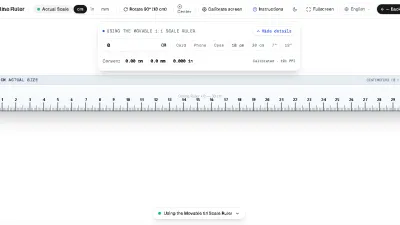
The simplest and most accurate solution is sitting right in front of you. By opening our Online Ruler Actual Size (1:1) directly in your mobile or desktop browser, your screen becomes a millimeter-perfect physical ruler.
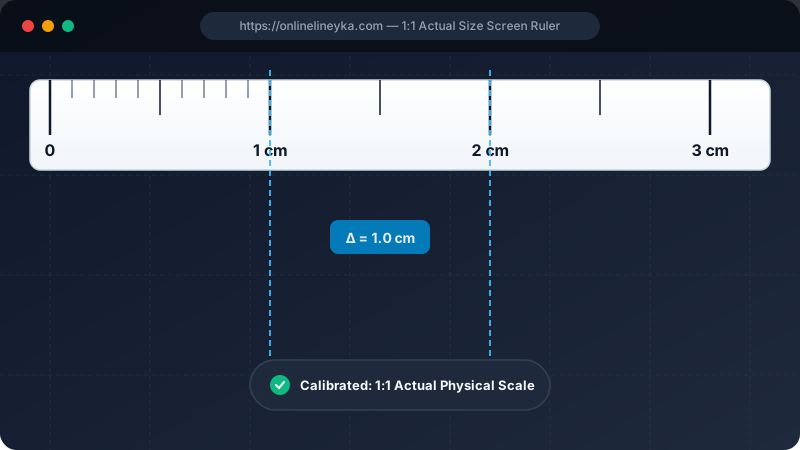
💡 How to get 100% accuracy on screen:
- Visit onlinelineyka.com on your phone or laptop.
- Choose your preferred unit: Centimeters, Inches, or Millimeters.
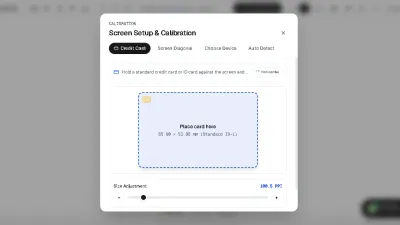
- For critical millimeter accuracy, tap the Calibrate tool and align any bank card against the on-screen card outline.
2. Measure with a Standard Credit or Debit Card
Almost every payment card, driver's license, and transit smart card in the world adheres to the international ISO/IEC 7810 ID-1 standard. This makes credit cards one of the most reliable measuring tools on earth.
| Dimension | Metric (Millimeters / CM) | Imperial (Inches) |
|---|---|---|
| Width (Long Edge) | 85.60 mm (8.56 cm) | 3.370 inches (approx. 3 3/8″) |
| Height (Short Edge) | 53.98 mm (5.40 cm) | 2.125 inches (approx. 2 1/8″) |
| Corner Radius | 3.18 mm | 1/8 inch |
3. Use Paper Currency and Coins
Government-minted bank notes and coins are manufactured with strict dimensional tolerances. If you carry cash in your wallet, you carry a calibrated scale:
- US Dollar Bill (any denomination): 6.14 inches long (15.6 cm) by 2.61 inches high (6.6 cm). Folded in half: 3.07 inches. Folded into quarters: 1.53 inches.
- Euro Banknotes: A €5 note is exactly 120 mm × 62 mm; a €10 note is 127 mm × 67 mm; a €20 note is 133 mm × 72 mm.
- British £5 Note: 125 mm × 65 mm.
- US Quarter: Diameter is 0.955 inches (24.26 mm) — approximately 1 inch.
- US Penny: Exactly 0.75 inches (19.05 mm) in diameter — exactly 3/4 of an inch.
4. Use Standard A4 or Letter Size Paper
Printer paper is ubiquitous in homes and offices. If you need to measure a larger item like a desk, box, or room corner, regular sheets of paper serve as great modular measuring units:
- ISO A4 Paper (Worldwide standard): 210 mm × 297 mm (8.27 × 11.69 inches). Three A4 sheets placed end-to-end measure almost exactly 89 cm (about 35 inches).
- US Letter Paper (North America): 8.5 × 11.0 inches (215.9 × 279.4 mm). Two sheets end-to-end measure exactly 22 inches (55.9 cm).
- Post-it Note (Standard Square): Exactly 3.0 × 3.0 inches (76.2 × 76.2 mm).
5. Measure with Your Hands and Fingers
Throughout history, human body parts were the original basis of measurement systems. While human dimensions vary, knowing your personal landmarks gives you a reliable reference:
- Thumb Tip to First Knuckle: Roughly 1 inch (2.5 cm) for the average adult.
- Index Finger Width (across fingernail): Approximately 1 cm (0.4 inches).
- Hand Span (tip of thumb to tip of pinky outstretched): Between 7.5 to 9 inches (19 to 23 cm) for most adults.
- Foot Length: Adult male US shoe size 9–10 corresponds to approximately 10.5 to 11 inches foot length.
6. Other Common Items with Fixed Dimensions
- Standard Business Card: 3.5 inches × 2.0 inches (88.9 × 50.8 mm).
- Standard Soda Can: 4.83 inches tall (12.27 cm) and 2.6 inches in diameter (6.6 cm).
- Standard AAA Battery: 44.5 mm (1.75 inches) in length; 10.5 mm in diameter.
- Standard AA Battery: 50.5 mm (1.99 inches) in length; 14.5 mm in diameter.
7. Golden Rules for Accurate Improvised Measuring
- Eliminate gaps and overlaps: When chaining multiple cards or bills, use a sharp pencil to mark edges so error does not compound.
- Keep the surface flat: Flexible bills or folded paper can curl and introduce a 5-10% error margin.
- Verify with an online ruler: Always double check critical measurements using our calibrated Movable Real Scale Ruler before cutting materials or purchasing items.